

At 94, Andrew Young Leads Atlanta Peace Walk With a Message for the World

By Stacy M. Brown
Senior Global Correspondent
ATLANTA — At 94, legendary Ambassador Andrew Young returned to the Atlanta neighborhood where he helped make history, leading a peace walk through Rodney Cook Sr. Park and stopping along the way to tell the stories behind the men whose bronze likenesses now stand there beside his own.
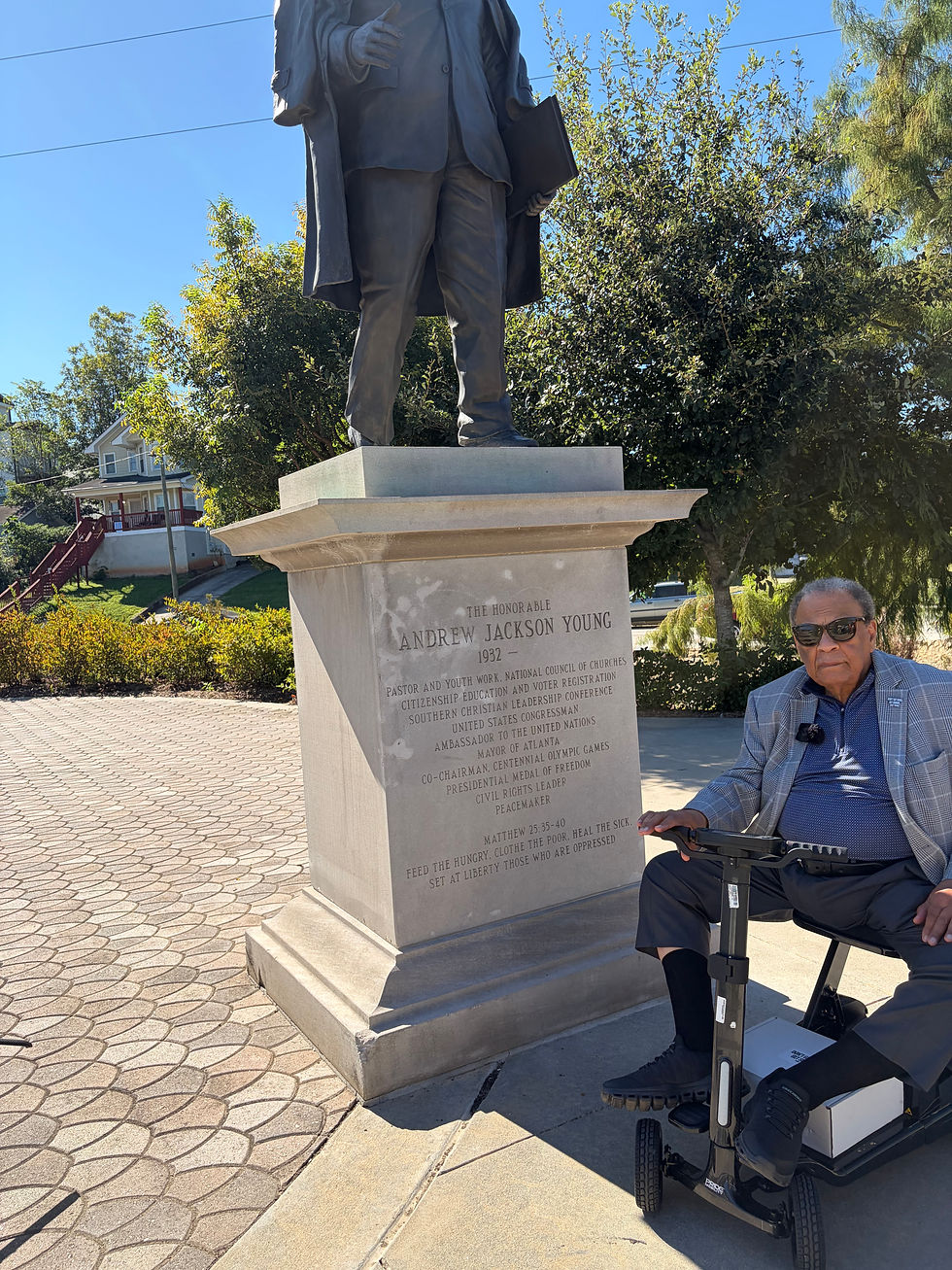
Moving through the park on his motorized scooter, Young drew politicians, foundation members, prospective sponsors, and neighborhood residents along a one-mile route that became part peace march and part living history lesson, as he recalled Martin Luther King Jr., John Lewis, President John F. Kennedy, and the lessons in nonviolence that shaped his own life.
Local politicians, Andrew Young Foundation members, prospective sponsors, and residents of the surrounding neighborhood gathered for the inaugural Peace Walk, following Young through the manicured park in historic Vine City as he linked his generation's battles to his call for peace in a world still consumed by war.
“If you get up on a pretty Saturday morning like this and come out just to walk a mile for peace, you still believe that all things are possible,” Young said. “Because there certainly is; if you look at the news, wars are going on all over the world.”
The Sept. 26 walk coincided with the United Nations’ International Day for the Total Elimination of Nuclear Weapons, an observance the U.N. General Assembly established to promote nuclear disarmament.
The idea came from Les McCurdy, the veteran comedian, podcast host, entrepreneur, and founder of McCurdy’s Comedy Theatre in Sarasota, Florida. Years ago, McCurdy envisioned one billion people worldwide walking one mile on the same day to draw attention to nuclear weapons and the need for peace.
The first attempt never gained traction.
“We tried it,” McCurdy told the crowd. “It did not go anywhere. We didn’t have the power or the influence. We realized it.”
After about 20 years without seeing each other, McCurdy eventually reconnected with his childhood friend J.B. Vick, founder and president of MVP Studios and a confidant of Young. During their conversations, McCurdy told Vick about the peace walk he had tried to launch years earlier.
Five weeks before the gathering, McCurdy said, Vick texted him after visiting Young. Young had mentioned he was interested in holding a peace walk, and Vick told him that his childhood friend had been carrying around almost exactly that idea.
“And Mr. Young said, ‘Sounds like a fine day for a walk,’” McCurdy recalled.
McCurdy now wants the gathering to serve as the starting point for the international event he originally envisioned. His goal is to have as many as one billion people walk a mile wherever they are on Sept. 26, with prominent entertainers, athletes, business leaders, and others helping draw attention to nuclear disarmament.
“It shouldn’t be an angry protest,” McCurdy said. “It should be a coming together. It should be a celebration of life.”
Young’s journey through the park offered a living history lesson just a few feet from some of the places where that history was made. King’s family home is nearby, and the park contains statues of King, Lewis, and Young. On a hill overlooking the area, the Andrew Young Foundation plans to build the Andrew Young International Institute for Peace and Reconciliation.
Young stopped at each statue to talk.
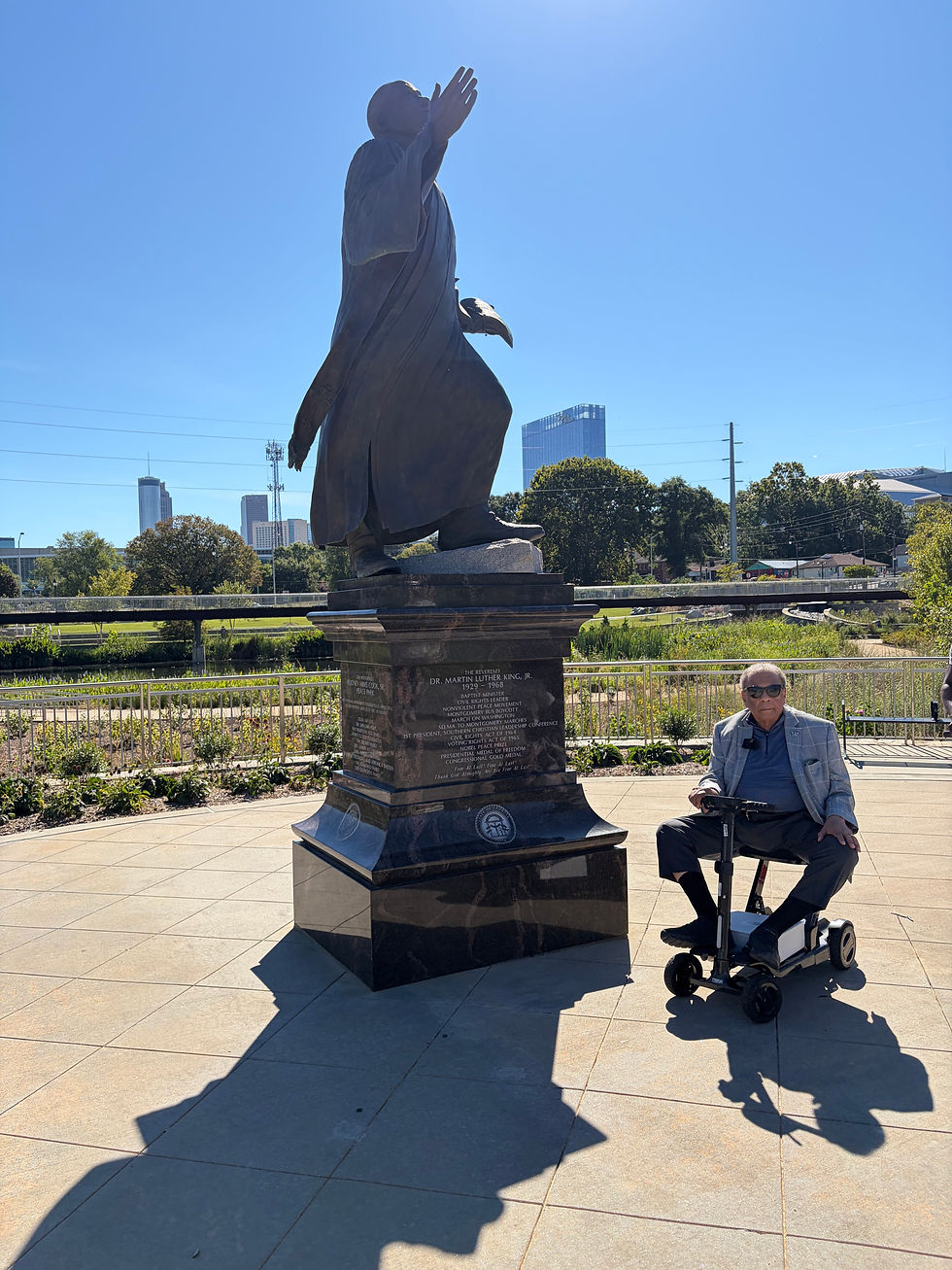
Standing before King’s likeness, he recalled King’s ties to India and Mahatma Gandhi’s philosophy of nonviolence. He also retold the story of the 1960 presidential campaign, when Kennedy called Coretta Scott King after her husband was jailed following an Atlanta protest.
Young recalled that word of the call quickly reached King’s father, Martin Luther King Sr., who had been leaning toward Richard Nixon. According to Young, the elder King was so moved by Kennedy’s check on his daughter-in-law while her husband sat in jail that he decided to throw his support behind the Democratic nominee.
“We think that is how a number of states were changed, and Kennedy became the president,” Young said. “It was always one of these accidental check-on-you-and-see-how-you’re-doing phone calls that turned out to have a global significance.”
At Lewis’ statue, Young remembered a man whose soft-spoken demeanor gave little indication of the physical courage he would repeatedly display during the civil rights movement.
Young recalled asking activists why Lewis, quiet, humble, and speaking with a slight lisp, emerged as a leader among young people who knew demonstrations could end in beatings, arrests, and imprisonment.
“There was nobody in the entire student movement that could match John Lewis’ courage,” Young reminisced.
Lewis did not stand safely behind others and order them into danger, Young said. He went with them.
“He was a leader always in the middle of the pack and encouraging people to do things that they were not normally courageous enough to do,” Young told the gathering. “But he made heroes out of those around him.”
Young also recalled how his path led him south. He was living in New York, had recently bought a house, and had a good job when, after watching television coverage of the movement, his wife told him she was going home to the South.
“I said, ‘You are home. We just bought this house,’” Young recalled.
Her answer was different.
“No, this is New York,” he remembered her saying. “My home is down home.”
Young eventually returned to the South and became one of King’s closest aides within the Southern Christian Leadership Conference.
The Peace Walk route also brought him face-to-face with his own bronze likeness. Young read aloud the accomplishments inscribed on it: pastor, youth worker, civil rights leader, congressman, United Nations ambassador, Atlanta mayor, co-chairman of the Centennial Olympic Games, and recipient of the Presidential Medal of Freedom.
He read the biblical charge from Matthew 25 that accompanies the statue: “Feed the hungry, clothe the poor, and heal the sick, and set at liberty those who are oppressed.”
“And that’s basically what we’re trying to do,” Young explained.
Young’s message on nonviolence predates King, the Southern Christian Leadership Conference, and the United Nations. He traced it to his childhood in New Orleans, where he said an Irish grocery store stood about 50 yards from his home, an Italian bar sat nearby, and the local Nazi Party had a presence at another corner.
His father told him early on that fighting his way through such a world was not an option.
“You’re never going to be big enough to beat everybody, so you better learn to get along with everybody,” Young recalled his father telling him. “You better try to understand people and help them understand you. And whatever you do, don’t get mad. Get smart.”
His father explained that losing his temper would send the blood rushing “from your head to your fist to your feet,” leaving him wanting either to fight or to run.
“Neither one of those will produce what you need,” Young said. “And what you need is peace and understanding and an appreciation of people who are different than you.”
Young carried that philosophy into the Carter administration when he became U.S. ambassador to the United Nations in 1977. Asked about the institution after another week of speeches and disputes at the U.N. General Assembly, he remembered an organization where nations could make their disagreements known without ending the conversation.
“The U.N. has always been a place where people express their views nonviolently,” Young said. “I never had anybody walk out on me. In fact, I don’t remember anybody walking out on anybody during the three years I was at the U.N., but they found ways to let it be known that they disagreed with whoever was speaking.”
Young noted that his work at the U.N. benefited from relationships he had already built with African leaders, relationships that became important as the Carter administration dealt with independence movements and conflicts across southern Africa.
Decades later, Young wants the institute planned beside Rodney Cook Sr. Park to bring people together around many of the same principles. He pointed to Atlanta’s universities, international population, and civil rights history as resources he could marshal toward conflict resolution.
“There’s plenty of room for differences, but there’s even more room for reconciliation,” Young said. “And when we get together, and we start seeing through these differences to the things that we have in common,” peace becomes possible.
Young looked across the park, where King, Lewis, and his own likeness now stand, and toward the area where the peace institute is planned.
“Let’s decide that we’re going to make peace on Earth and let it begin here with us,” he said.
Before the gathering ended, Young returned to the reason people had followed his scooter through the park on a Saturday morning.
“Let’s enjoy the blessings and share them with our friends, our enemies, and many that are unborn,” he said. “May we prepare a more peaceful planet for the future.”


Comments