

The Fight for Economic Justice: Ending the Subminimum Wage

Updated: Mar 3
A Call to Action
NEW YORK—Civil rights leaders stood inside the New York Hilton Midtown and declared that the fight to end the subminimum wage is the unfinished business of the Civil Rights Movement.
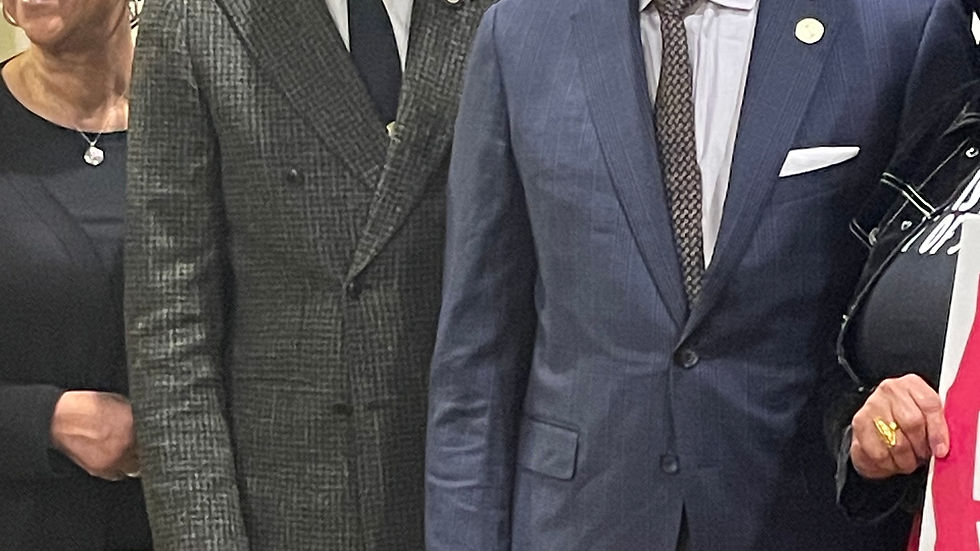
“As we think about the partnership with One Fair Wage and the relationship with labor, you know that NAACP and labor are married,” said Jamal R. Watkins, Senior Vice President of Strategy and Advancement at the NAACP. “The movement of working people is the movement of Black people, the movement of Brown people, the movement of women, the movement of children, and the movement of folks who had to make this country what it is,” Watkins demanded during a spirited press conference.
Held during the NAACP National Leadership Convening and during Black History Month, the gathering brought together NAACP President Derrick Johnson, National Urban League leadership, New York NAACP Chair L. Joy Williams, New York City Council Member Yusef Salaam, One Fair Wage President and Co-founder Saru Jayaraman, tipped restaurant workers, small business owners, and labor advocates.
Together, they called for the passage of Living Wage for All legislation newly introduced in New York City and New York State, as well as for similar legislation to be introduced in Congress.
The Need for Change
The proposed measures would raise the minimum wage closer to the cost of living, setting it at least $30 an hour in New York and $25 an hour federally. Additionally, they aim to eliminate all subminimum wages, including the tipped minimum wage, which remains at $2.13 an hour under federal law.
Organizers connected the current campaign to past efforts, particularly the work of Saru Jayaraman, who organized restaurant workers after the September 11 attacks. “This is the 25th anniversary of 9/11; on that day, there was a restaurant at the top of the World Trade Center—a restaurant called Windows on the World,” Jayaraman said.

“On that morning, 73 workers died, and 13,000 workers lost their jobs. I was asked as a young organizer to start a relief center for restaurant workers in the aftermath of the tragedy. What started as a relief center for restaurant workers grew into a national restaurant workers organization,” Jayaraman continued.
“Everywhere we went, restaurant workers would always say, 'It's my wages, it’s my wages.' There are 13.6 million workers in America, 700,000 here in New York. Yet, it is the absolute lowest-paying employer and has been for generations, dating back to emancipation.”
The Impact of Tipped Wages
At the center of the event was the release of a February 2026 report from One Fair Wage titled “Still Waiting for Equal Pay: How $2.13 Suppresses Tipped Workers’ Wages and Exacerbates Black Women’s Pay Gap.”
The report concludes that the federal tipped wage of $2.13 an hour depresses earnings and widens racial and gender wage gaps in the restaurant industry. According to the report, Black women tipped workers earn just 63 cents for every dollar earned by white men in the same industry.
The research also concluded that more than 70 percent of tipped restaurant workers nationwide earn under $25,372 annually, and that 95 percent earn less than $57,000. In states where the tipped wage remains $2.13, tipped restaurant workers have a median individual income of $15,149 compared to a national median income of $42,220.
Historical Context
Speakers emphasized that the subminimum wage traces directly to post-Emancipation labor practices. These practices forced Black workers into tip-dependent jobs without guaranteed pay. The National Restaurant Association has long defended this system.
They also warned against the federal Tipped Employee Protection Act, H.R. 2312. The bill, according to Congress.gov, would modify the definition of a tipped employee under the Fair Labor Standards Act to broaden who qualifies as a tipped employee. Advocates described the proposal as an expansion of subminimum wage loopholes that would weaken worker protections nationwide.
A Civil Rights Imperative
Yusef Salaam, a member of the Exonerated Five, framed the issue as a civil rights imperative. “Today we recognize Black History Month, and as we recognize Black History Month, we also recognize that the fight for economic justice is inseparable from the ongoing struggle of racial justice,” Salaam stated.
“This gathering honors the leadership, resilience, and contribution of Black workers who have always been at the forefront of movements for fairness, dignity, and opportunity. We must also confront the painful truth that some minimum wages are the direct legacy of Jim Crow policies designed to exclude Black workers from basic labor protections,” Salaam continued.
“That legacy has not disappeared. It continues today, morphing into disproportionately harming workers of color who are overrepresented in low-wage and tipped industries.”
The Heart of Democratic Power
Derrick Johnson, president of the NAACP, argued that wage policy sits at the heart of democratic power. “Our job is to serve and create a better society for all. If you think about how workers are treated, particularly service workers, it is inhumane,” Johnson remarked.
“It is inhumane for someone to work 9, 10, or 12 hours to almost make their house payments. The history of the human rights movement in this country that we call the Civil Rights Movement is based on three basic pillars: our ability to exercise our vote; our ability to ensure the public policy that arises from our vote prepares our young people for a future, education, and the abilities of our communities not to be exploited for free and cheap labor,” Johnson said.
Conclusion
The fight to end the subminimum wage is not just about pay; it is about dignity and respect for all workers. As we reflect on the past, we must also look forward to a future where economic justice is a reality for everyone. The voices of leaders like Watkins, Jayaraman, Salaam, and Johnson remind us that this struggle is far from over.
In this ongoing battle, we must unite to ensure that the rights of all workers are upheld, and that the legacy of exploitation is finally put to rest. Together, we can create a more equitable society where every worker is valued and compensated fairly.



Comments