

Supreme Court Upholds Mail Ballot Grace Periods and Denies Trump's Appeals in Key Voting Cases

Black Press Media USA Staff
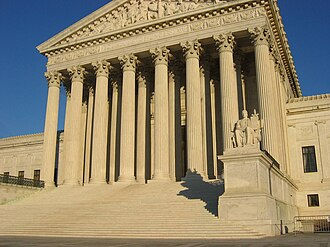
The U.S. Supreme Court handed down a series of consequential decisions Monday affecting voting rights, presidential authority, and the Federal Reserve, beginning with a ruling that preserves states’ authority to count mail ballots received after Election Day when those ballots were mailed on time under state law.
In a 5-4 decision, the Court upheld Mississippi’s absentee ballot law, allowing election officials to count ballots postmarked by Election Day that arrive up to five business days later. The ruling leaves intact similar laws in 18 states and territories, as well as separate grace periods many states provide for military and overseas voters.
“A ballot mailed on time is a vote cast on time, and the Court just affirmed what’s been true for over a century,” Sophia Lin Lakin, director of the American Civil Liberties Union’s Voting Rights Project, said in a statement obtained by the Washington Informer.
“These voters did everything right—they followed the rules and got their ballots in the mail. They shouldn’t lose their voice because a postal truck ran late, and now they won’t. This is how it’s supposed to work. States decide how to count their voters’ ballots, and that authority is intact heading into November.”
The decision overturns a ruling by the U.S. Court of Appeals for the 5th Circuit that interpreted federal Election Day statutes to prohibit counting ballots received after Election Day, even when voters complied with every deadline established by state law. The ACLU, which filed a friend-of-the-court brief, argued that the appeals court’s interpretation would have disrupted long-standing absentee ballot laws and disproportionately affected voters with disabilities, rural residents, older Americans, military personnel serving overseas and working people who depend on voting by mail.
The case stemmed from a challenge brought by the Republican National Committee and the Mississippi Republican Party, which argued that Congress established a single federal Election Day and that ballots received afterward could not be counted. Voting rights advocates countered that states have long set the rules for administering absentee voting, including reasonable receipt periods for ballots mailed on time.
The issue extends well beyond Mississippi. According to court filings, 18 states and territories allow election officials to count ballots postmarked by Election Day if they arrive within a prescribed period. Another dozen states provide similar grace periods for military and overseas ballots. Washington Secretary of State Steve Hobbs previously said more than 250,000 ballots mailed on time during the 2024 election reached election officials after Election Day because of postal delivery delays.
Monday’s ruling also represented another legal defeat for President Donald Trump, who has repeatedly sought to eliminate post-Election Day ballot receipt periods. Before the 2024 election, Trump and the Republican National Committee filed lawsuits challenging similar laws, including Mississippi’s. Trump also signed an executive order requiring ballots to be received by Election Day in federal elections, though lower courts blocked that order.
Later Monday, the Supreme Court declined to hear Trump’s appeal of the $5 million civil judgment awarded to writer E. Jean Carroll, leaving intact a New York jury’s finding that Trump sexually abused and defamed her. The court's decision leaves in place both the jury verdict and the ruling of the U.S. Court of Appeals for the 2nd Circuit affirming the judgment.
Carroll filed suit in 2022, alleging Trump sexually assaulted her in a dressing room at a Manhattan department store in 1996 and later defamed her after she publicly disclosed the allegation. During his appeal, Trump argued the trial court improperly admitted testimony from other women who accused him of sexual assault, as well as the 2005 "Access Hollywood" recording. The Supreme Court denied review without a noted dissent. A separate appeal involving an $83 million defamation judgment that Carroll won is expected to reach the justices.
The justices also rejected Trump’s latest effort to remove Federal Reserve Governor Lisa Cook while litigation over her dismissal continues.
In another 5-4 decision, the Court left in place a lower court order allowing Cook to remain on the Federal Reserve Board of Governors while her lawsuit proceeds. Trump sought to remove Cook after alleging mortgage fraud. Cook disputes those allegations and has challenged her dismissal in federal court. Chief Justice John Roberts wrote the majority opinion, joined by Justices Sonia Sotomayor, Elena Kagan, Brett Kavanaugh, and Ketanji Brown Jackson.
Cook, an economist nominated by former President Joe Biden and the first Black woman to serve on the Federal Reserve Board, argues that federal law protects governors from removal without cause to preserve the central bank’s independence. Monday’s decision does not resolve the merits of that dispute. Instead, it allows Cook to remain in office while the courts decide whether Trump’s attempt to remove her was lawful.
The Supreme Court also agreed to hear a challenge involving Arizona’s voter registration laws, setting up another closely watched election case during its next term. The dispute centers on Arizona laws requiring documentary proof of citizenship for certain voter registrations and voter-roll maintenance procedures that lower courts found conflict with federal election law.
Lakin said Monday’s ruling protects voters who followed the law and reinforces states’ longstanding authority to administer elections.
“A ballot mailed on time is a vote cast on time, and the Court just affirmed what’s been true for over a century,” she said.


Comments